
Canoa Quebrada
All of Brazil, within reach.

Adopted in 1922, it echoes the national flag: a green field with a yellow rhombus and a white disc bearing the state arms. The arms show a jangada raft, a carnaúba palm, the Mucuripe lighthouse and a fort, with seven stars for the state's mesoregions and a dove recalling the early abolition of slavery.
Canoa Quebrada in pictures
About Canoa Quebrada
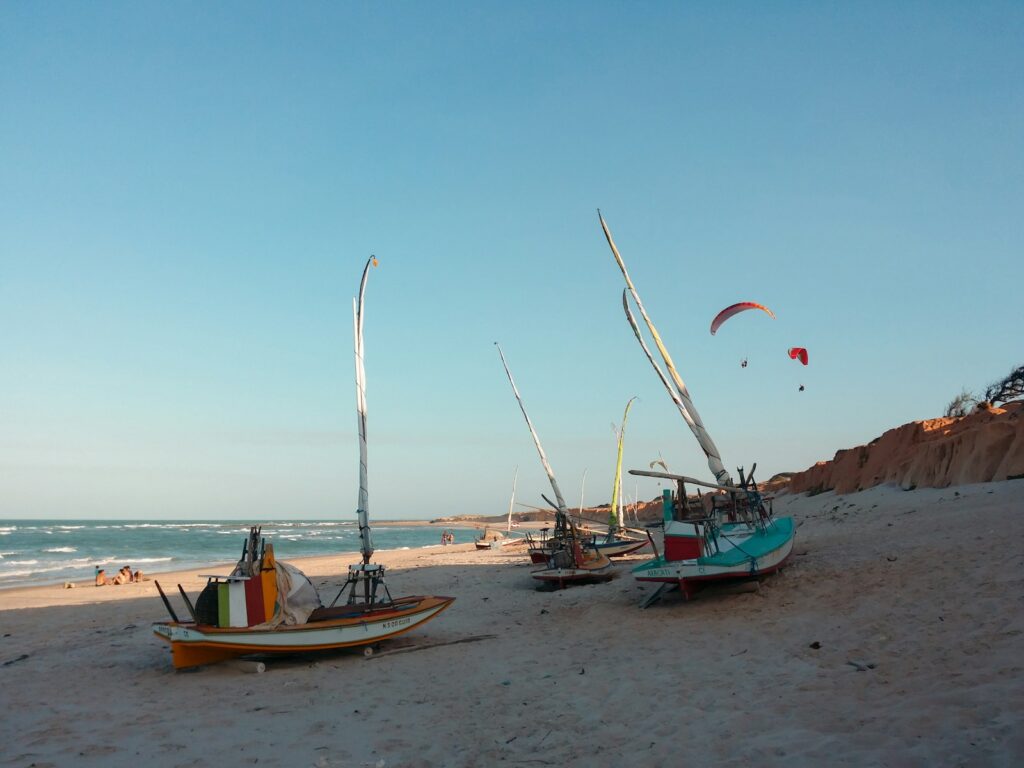
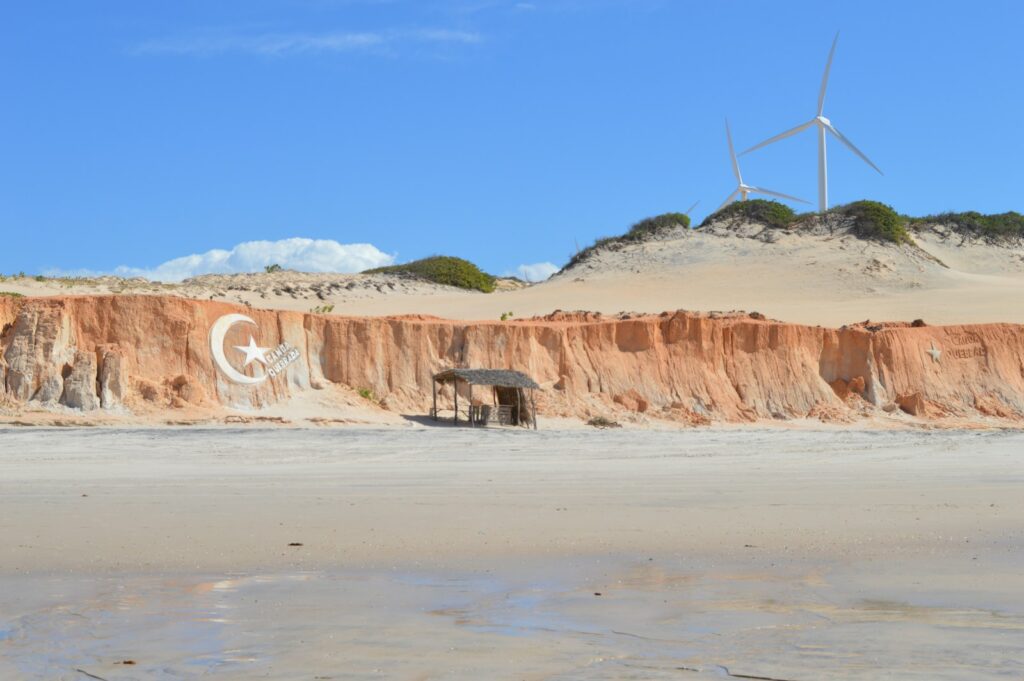
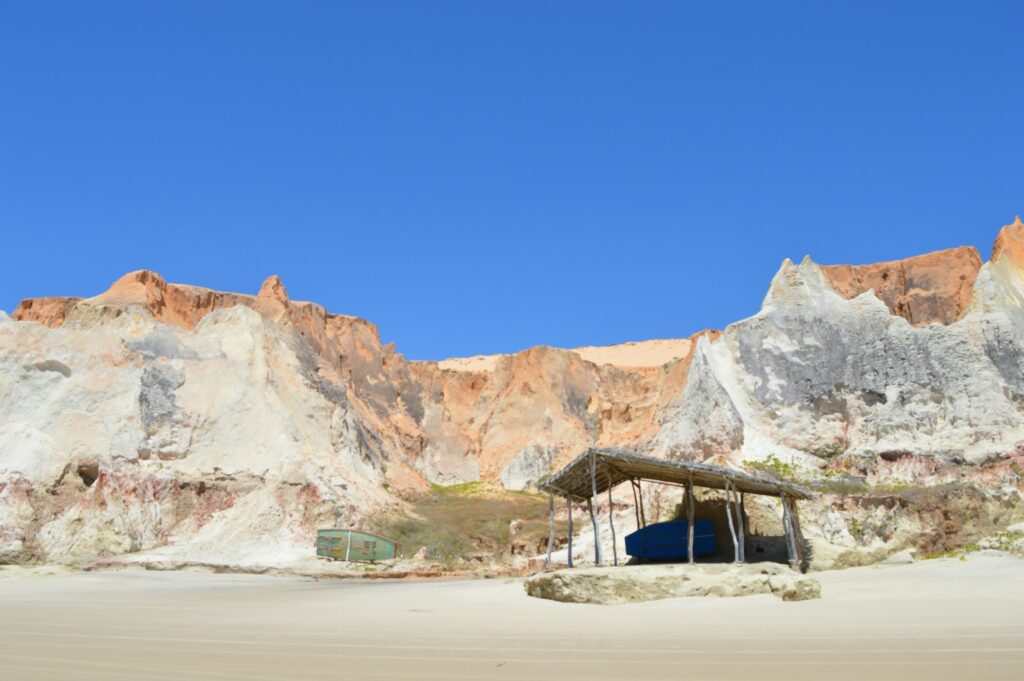
Canoa Quebrada is a former fishing village on the east coast of Ceará, in the municipality of Aracati, about 160 km from Fortaleza. It sits on reddish cliffs of up to thirty metres above the sea, backed by dunes and wind farms, with jangada rafts drawn up on the beach below and a lively main street of restaurants, bars and craft shops. Discovered by French filmmakers in the 1960s and by hippies in the 1970s, it became a mainstream destination after the late 1990s, and a municipal environmental protection area has regulated its coastal occupation since 1998. Twelve kilometres inland, Aracati keeps a historic centre listed by IPHAN in 2000, with 275 protected buildings from its cattle-trade prosperity. Along the CE-040 closer to Fortaleza, the Morro Branco cliffs in Beberibe form a labyrinth of coloured sands, protected as a state natural monument, and west of the capital Cumbuco is one of Brazil's best-known kitesurf beaches. For agencies, this coast works as a relaxed beach extension from Fortaleza or as a leg on a longer Nordeste coastal itinerary, suited to couples, small groups and incentive programs built around buggy rides over the dunes, jangada outings, sunset viewpoints and kitesurf. The villages have small pousadas and boutique properties rather than large resorts, which favours private and small-group departures. Logistics are straightforward but road-based: most clients land in Fortaleza and transfer by coach or private car, with Morro Branco a natural stop on the way. The regional airport at Aracati reopens to scheduled service in October 2026 with a twice-weekly Azul route linking it to Belo Horizonte and Fortaleza, which should be treated as a supplement to Fortaleza rather than the main gateway. Cliff edges are fragile and eroding, so viewpoints and walks need guiding and respect for posted limits.
Fortaleza–Pinto Martins International Airport
Ceará's main gateway, operated by Fraport Brasil since 2018, with domestic hubs nationwide and direct flights to Europe including Lisbon, Paris and Madrid.
Canoa Quebrada Dragão do Mar Regional Airport
Regional airport opened in 2012, without scheduled flights for about a year until Azul's twice-weekly Belo Horizonte (Confins) route via Fortaleza, starting October 2026.
How Canoa Quebrada came to be
Sourced milestones your team can use for guest briefings and storytelling, not filler copy.
Curiosities & practical notes
What's on the table
Baião de dois
Rice and green beans cooked together with carne de sol and queijo coalho, Ceará's signature everyday dish.
Caranguejada
Whole crabs cooked in a seasoned broth and cracked at the table with wooden mallets, served with cassava flour and vinaigrette.
Moqueca cearense
A coastal fish and shrimp stew made with coconut milk, olive oil and fresh vegetables, without the palm oil used in Bahia.
Carne de sol com macaxeira
Salted, sun-cured beef served with boiled or butter-fried cassava.
Paçoca de carne de sol
Desalted sun-cured beef pounded in a mortar with cassava flour and red onion.
Tapioca
A cassava-starch crêpe filled with sweet or savoury ingredients, often coconut, eaten at breakfast or in the afternoon.
What there is to see
Marked where a site carries UNESCO World Heritage status directly, versus a locally or nationally protected landmark.
Falésias de Canoa Quebrada
Reddish cliffs and dunes above the beach, the classic viewpoint of the village and setting for buggy and sunset outings.
Rua Dragão do Mar (Broadway)
Canoa Quebrada's pedestrian main street of restaurants, bars and craft shops, the social centre of the village at night.
Centro Histórico de Aracati
A historic centre listed by IPHAN in 2000, with 275 protected buildings including tiled sobrados, churches and civic buildings.
Casa de Câmara e Cadeia de Aracati
The former town hall and jail completed in 1779, still home to the city council.
Museu Jaguaribano
A regional museum in Aracati housed in the Sobrado do Barão, a neoclassical mansion faced with Portuguese tiles.
Falésias de Morro Branco
A labyrinth of coloured sand cliffs in Beberibe, about 85 km from Fortaleza, protected as a state natural monument since 2004.
Cumbuco and Lagoa do Cauípe
A beach village about 35 km from Fortaleza known for kitesurfing, with dune buggy routes to lagoons such as Cauípe, Parnamirim and Banana.
What else we brief agencies on
This is what we prepare for every RFP, whether or not it's published on this page yet:
On request for every proposal
- Best season / weather windows and blackout dates for groups & MICE
- Permit and quota logistics for regulated attractions, lead time and group-size caps
- Accessibility notes and physical-difficulty ratings per activity
- Vetted ground partners, guides and transport already used on past programs
- Sustainability / certification credentials relevant to client RFPs, where they genuinely exist
- Real, checked room and vehicle availability for your travel dates, not a generic quote
