Maceió
All of Brazil, within reach.

Maceió's municipal flag has three horizontal stripes, green, white, and blue, split by a thin wavy red line running through the white stripe to represent the Salgadinho Stream, with the green and blue alluding to the Atlantic Ocean and Mundaú Lagoon and a white central disc bearing the municipal coat of arms created by Théo Brandão; it was adopted by Municipal Law No. 868 on May 29, 1962.
Maceió in pictures




About Maceió
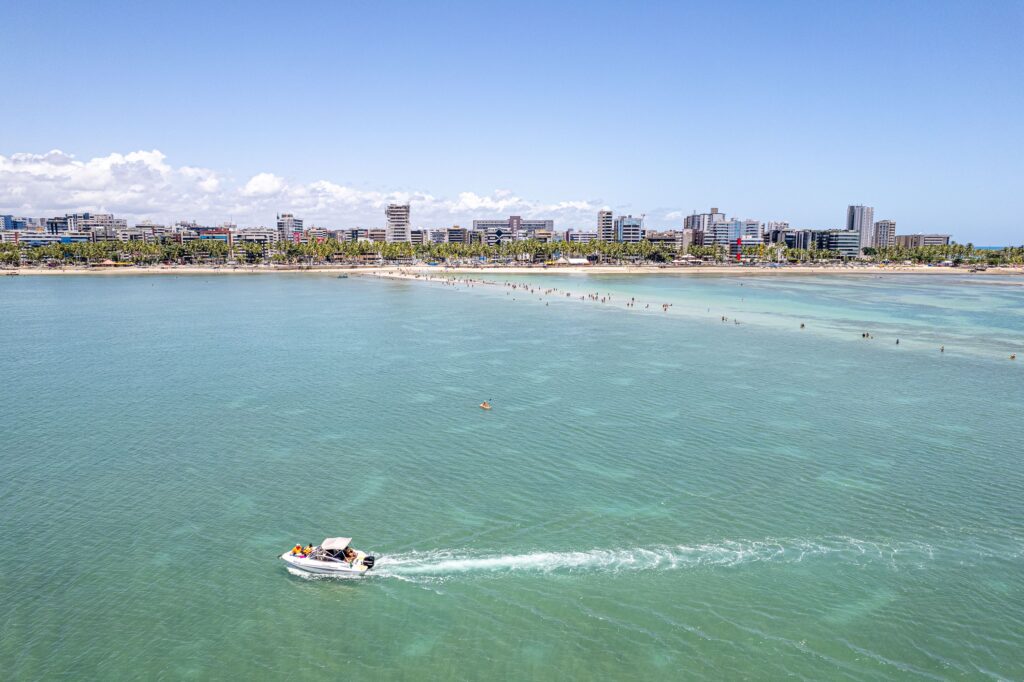
Maceió is the capital of Alagoas and the anchor gateway to Brazil's northeastern 'Coconut Coast,' valued by tour operators for its calm, reef-protected turquoise waters, tide-timed natural pool excursions, and a continuous urban beachfront (Pajuçara–Ponta Verde–Jatiúca) that keeps hotels, restaurants and jangada docks within easy walking distance of one another. Zumbi dos Palmares International Airport (MCZ) sits roughly 25 km from the main hotel strip and has posted steady year-on-year passenger growth, supporting expanding charter and scheduled-service programs. Beyond the beach, the destination offers half-day cultural add-ons, the nationally listed colonial town of Marechal Deodoro, the filé lace-embroidery village of Pontal da Barra on the Mundaú-Manguaba lagoon system, and a compact historic center, giving agencies a flexible base for both classic sun-and-sea itineraries and cultural extensions along the Alagoas coastline.
Maceió–Zumbi dos Palmares International Airport
How Maceió came to be
Sourced milestones your team can use for guest briefings and storytelling, not filler copy.
Curiosities & practical notes
What's on the table
Sururu (caldinho de sururu)
a coconut-milk broth built on a small lagoon mollusk considered the culinary symbol of Maceió.
Peixada Alagoana
a fish stew simmered with coconut milk and vegetables, typically served with rice and pirão.
Camarão Bar das Ostras
a shrimp dish whose recipe was kept secret for decades before being revealed in 2011 and later recognized as Intangible Cultural Heritage of Alagoas.
Carne do Sol com queijo coalho
salted, sun-dried beef paired with grilled coalho cheese, a Northeastern staple widely served in Maceió.
Chiclete de Camarão
shrimp in a tomato-and-cheese sauce, a dish that gained national fame after a TV feature on chef Wilson Caliari's recipe.
Língua bovina
a slow-braised beef tongue preparation featured on regional menus around the city.
What there is to see
Marked where a site carries UNESCO World Heritage status directly, versus a locally or nationally protected landmark.
Piscinas Naturais de Pajuçara
Offshore natural pools reachable by jangada raft, viewable only at low tide (below ~0.7 m); Maceió's signature excursion.
Catedral Metropolitana Nossa Senhora dos Prazeres
The city's metropolitan cathedral overlooking Praça Dom Pedro II in the historic center.
Igreja de Nosso Senhor Bom Jesus dos Martírios
A colonial church notable for its façade covered in Portuguese azulejo tiles.
Museu Théo Brandão de Antropologia e Folclore
A folklore and anthropology museum run by the Federal University of Alagoas, housed in a historic mansion.
Memorial Teotônio Vilela
An Oscar Niemeyer-designed memorial on the Pajuçara waterfront honoring the Brazilian democracy advocate.
Pontal da Barra
A lakeside artisan village on Lagoa Mundaú, the state's largest open-air handicraft hub, known for filé lace embroidery.
Lagoas Mundaú e Manguaba
The twin coastal lagoons bordering the city, used for fishing and calm-water boat excursions.
Centro Histórico de Marechal Deodoro
Alagoas' original colonial capital (until 1839) and birthplace of Brazil's first president, nationally listed as Brazilian Historical Heritage by IPHAN in 2006; a common half-day trip from Maceió.
What else we brief agencies on
This is what we prepare for every RFP, whether or not it's published on this page yet:
On request for every proposal
- Best season / weather windows and blackout dates for groups & MICE
- Permit and quota logistics for regulated attractions, lead time and group-size caps
- Accessibility notes and physical-difficulty ratings per activity
- Vetted ground partners, guides and transport already used on past programs
- Sustainability / certification credentials relevant to client RFPs, where they genuinely exist
- Real, checked room and vehicle availability for your travel dates, not a generic quote