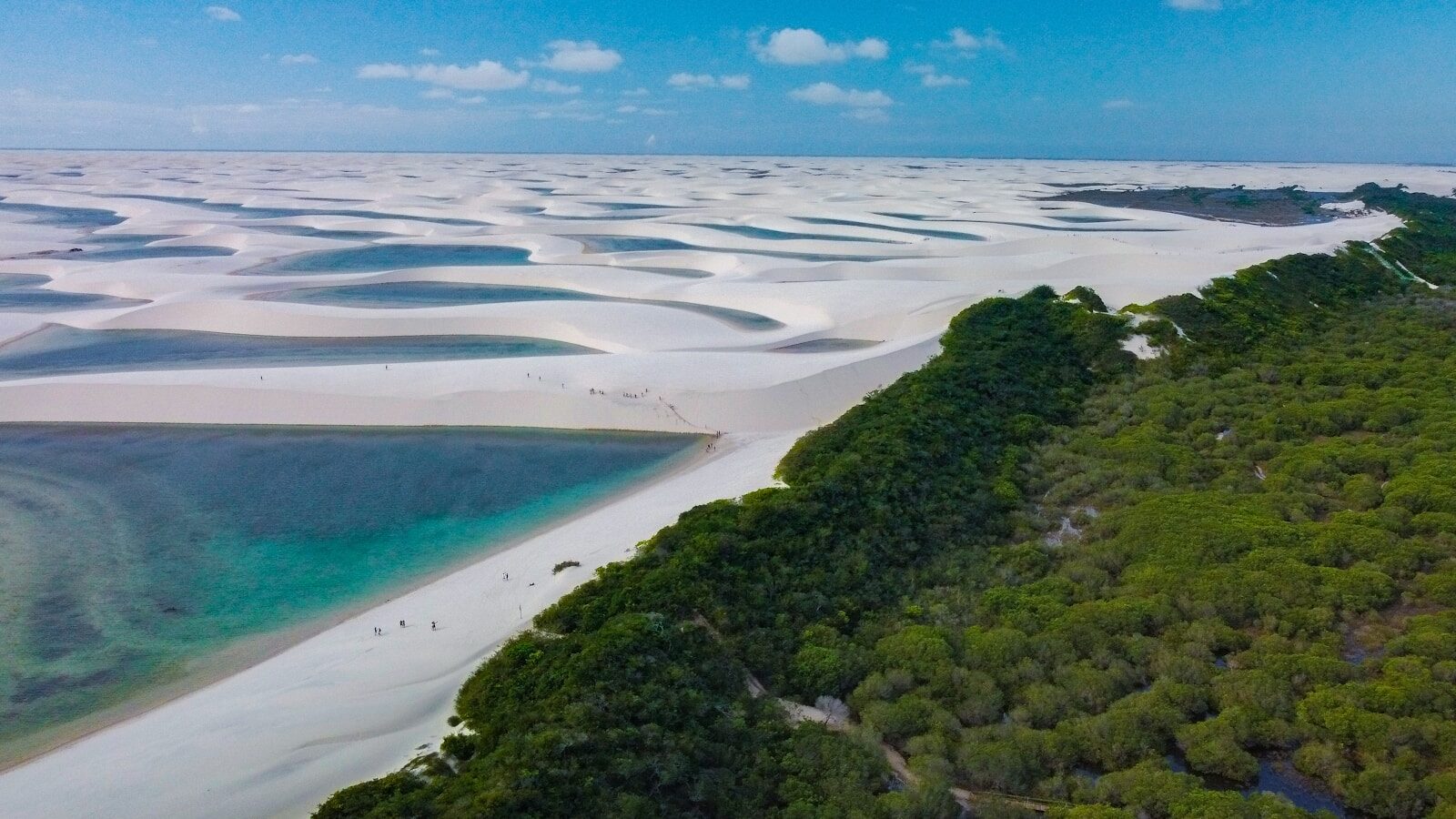
In July 2024, UNESCO inscribed Lençóis Maranhenses National Park on the World Heritage List, at the 46th session of the World Heritage Committee in New Delhi (UNESCO, 2024). The property covers 156,562 hectares, about 90,000 of them an open dune field that UNESCO describes as the largest in South America (UNESCO, 2024).
The listing changed the scale of demand. The park received more than 650,000 visitors in 2025, a record, against about 440,000 in 2024 and about 151,000 in 2019, the last year before the pandemic (ICMBio, January 2026).
How the Landscape Works
The lagoons are not permanent lakes. They are fed only by rain, form between the dunes during the wet season and often disappear in the dry months, returning the following year in different shapes and places (UNESCO, 2024). The dunes move as well, migrating inland by 4 to 25 meters a year (UNESCO, 2024).
That cycle sets the calendar. Rain falls mainly from February to May. The lagoons are at their fullest from May to August, still at a medium level in September and October, and low from November to January (Diário do Pará, July 2026).

Getting There
There are two main gateways. Barreirinhas sits 258 kilometers from São Luís, about four hours by road, and also has flights from São Luís and Parnaíba. Santo Amaro do Maranhão is 238 kilometers and about 3 hours 20 minutes from the capital, and closer to the dunes (Diário do Pará, July 2026).
From Santo Amaro, the 4×4 transfer to the nearest lagoons takes 20 to 40 minutes. Inside the park, only operators accredited by ICMBio can drive vehicles (Diário do Pará, July 2026). Atins, on the coast at the mouth of the Preguiças river, is the quieter base for clients who want the park without the town.
Access Is Changing
Growth has a cost. ICMBio lists soil compaction, trail erosion, waste and disturbance to wildlife among the risks, and is working with the municipalities of Barreirinhas, Santo Amaro and Primeira Cruz on a maximum number of visitors per area, the Número Balizador da Visitação (ICMBio, January 2026). UNESCO had already asked Brazil to set limits based on carrying capacity when it inscribed the site (UNESCO, 2024).
The pressure is already visible on the ground. On July 12, 2026, in high season, one of the access roads near Santo Amaro was blocked by a long line of cars, and entry to the park already requires a voucher issued by the municipalities (Imirante, citing ICMBio, July 2026).
What It Means for Your Programs
Sell Lençóis by month rather than as a fixed product: May to August for full lagoons, September and October for a quieter park with water still in place. Choose the gateway by the client: Santo Amaro for the shortest access, Atins for calm, Barreirinhas for flight connections.
And confirm guides and vehicles well ahead of July. Once a visitor cap is introduced, availability in the peak weeks is likely to tighten further, and the operators with confirmed bookings will be the ones still travelling.
For agencies planning Lençóis Maranhenses programs, our Lençóis Maranhenses briefing and the Maranhão state page cover access, seasons and ground services. World Heritage listings are published by the UNESCO World Heritage Centre.