
Rondônia
Western Amazon frontier state on the Bolivian border: Madeira-Mamoré railway heritage, a colonial fortress on the Guaporé and river-based nature programs.

The state
Rondônia sits in the southwestern Amazon, bordered by Bolivia along the Guaporé and Mamoré rivers and crossed by the Madeira, one of the great tributaries of the Amazon. Most of the state was once covered by rainforest, with cerrado in the south, and its modern identity was shaped by the rubber era, the Madeira-Mamoré railway and waves of settlers from the South, Southeast and Northeast from the 1970s onwards. The result is a frontier culture where Amazonian river cooking sits alongside southern churrasco and Bolivian influences, and where colonial and railway heritage gives the capital, Porto Velho, a story that few Amazon cities can tell.
For agencies, Rondônia works best as a special-interest destination: railway and frontier history in Porto Velho, river journeys on the Madeira and Guaporé, and expedition-style visits to the Real Forte Príncipe da Beira and the Bolivian border town of Guajará-Mirim. It pairs naturally with Acre or Amazonas on a western Amazon circuit. Distances are long and many secondary roads are unpaved, so programs should be built around Porto Velho with carefully planned overland or river transfers, ideally in the drier months when access is easier.
The climate is hot and humid all year, with a rainy season from roughly November to April and a drier window from June to August, which is the most practical period for river and overland programs.
Destinations 2
Destinations in this state covered by YourBrasil ground services.
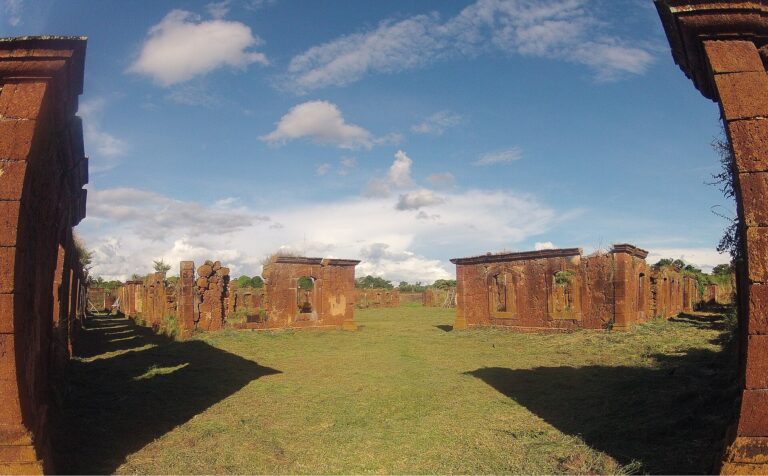
Guajará-Mirim
Guajará-Mirim stands on the Mamoré River in western Rondônia, directly across from the Bolivian town of Guayaramerín. With about 46,500 inhabitants in 2020, it…
Explore →
Porto Velho
Porto Velho, capital of Rondônia, stands on the eastern bank of the Madeira River, one of the main tributaries of the Amazon, in Brazil's…
Explore →Timeline
- 1775-1783
The Portuguese build the Real Forte Príncipe da Beira on the Guaporé River to secure the colonial frontier with Spanish territory.
- 1903
The Treaty of Petrópolis with Bolivia commits Brazil to building a railway around the rapids of the Madeira River.
- 1907-1912
The Madeira-Mamoré railway is built at a heavy human cost and officially opens on 7 September 1912.
- 1914
Porto Velho, which grew around the railway works, is officially founded as a municipality on 2 October.
- 1943
The Federal Territory of Guaporé is created, with Porto Velho as its capital.
- 1956
The territory is renamed Rondônia in honour of Marshal Cândido Rondon, whose expeditions opened telegraph lines through the region.
- 1972
The last trains run on the Madeira-Mamoré line, after its official deactivation in 1966.
- 1982
Rondônia is installed as a state on 4 January, after Congress approved its elevation in December 1981.
Landmarks
Madeira-Mamoré Railway complex, Porto Velho
Railway yard, workshops and the museum opened in 2023 that tell the story of the line, protected as national heritage by IPHAN.
Três Caixas d'Água, Porto Velho
The three early 20th-century metal water tanks and their square, the city's best-known symbol.
Real Forte Príncipe da Beira, Costa Marques
An 18th-century Portuguese fortress on the Guaporé, listed by IPHAN in 1950 and described as the largest Portuguese military building outside Europe.
Madeira River
A major Amazon tributary that shapes Porto Velho's waterfront and river journeys through the state.
Guajará-Mirim
A river town on the Mamoré facing Bolivia, known for its border commerce and boi-bumbá festival.
Pacaás Novos National Park
A park of about 765,000 hectares created in 1979, home to Pico do Tracoá (1,126 m), the state's highest point, and overlapping indigenous lands.
Guaporé valley
A remote border valley of floodplains and forest along the Guaporé River, with a large biological reserve and the historic fortress.
Festivals and events
Arraial Flor do Maracujá
Porto Velho's major June festival since 1983, with quadrilhas, boi-bumbá groups and live music, recognised as state intangible heritage.
Banda do Vai Quem Quer
A street carnival band founded in 1981 that fills central Porto Velho during Carnival, in February or March.
Out-of-season carnival
Porto Velho also stages a July carnival in the Bahian style, with trios elétricos and axé groups.
